Address
304 North Cardinal St.
Dorchester Center, MA 02124
Work Hours
Monday to Friday: 7AM - 7PM
Weekend: 10AM - 5PM
Address
304 North Cardinal St.
Dorchester Center, MA 02124
Work Hours
Monday to Friday: 7AM - 7PM
Weekend: 10AM - 5PM

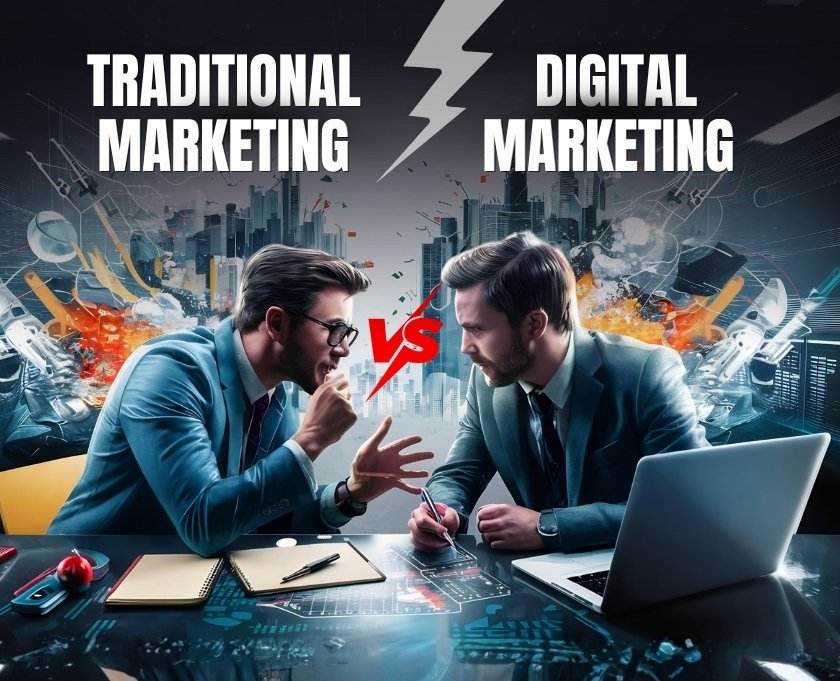
Marketing has always been the backbone of business growth, but the way brands connect with customers has evolved rapidly. With the rise of the internet, smartphones, and social media, businesses today face a critical decision: should they invest in digital marketing or rely on traditional marketing methods? Understanding the differences between these two approaches helps brands choose the strategy that delivers better results in the modern marketplace.
Traditional marketing refers to promotional methods that existed before the digital era. These include television advertisements, radio promotions, newspaper ads, magazines, billboards, flyers, and direct mail. For decades, traditional marketing was the primary way businesses built brand awareness and reached mass audiences.
Traditional marketing still holds value, especially for local businesses and brands targeting audiences with limited internet exposure. Television and print ads often create strong brand recall and trust, as consumers tend to perceive them as more established and credible. However, traditional marketing usually involves high costs, limited audience targeting, and minimal performance tracking, making it difficult to measure exact return on investment.
Digital marketing uses online platforms and technologies to promote products and services. It includes search engine optimization, social media marketing, content marketing, email marketing, pay-per-click advertising, influencer marketing, and more. Digital marketing allows businesses to connect with audiences where they spend most of their time—online.
One of the biggest advantages of digital marketing is precision targeting. Brands can reach users based on location, interests, behavior, age, and search intent. Digital campaigns are also measurable in real time, enabling marketers to track clicks, conversions, engagement, and sales. This flexibility allows businesses to optimize campaigns quickly and achieve better results with smaller budgets.
Cost plays a major role when choosing a marketing strategy. Traditional marketing often requires a large upfront investment, especially for television commercials, print ads, and outdoor hoardings. These costs can be challenging for startups and small businesses.
Digital marketing, on the other hand, offers scalable options for every budget. Businesses can start with minimal investment and increase spending as they see results. Online ads, social media campaigns, and SEO efforts generally provide higher returns at lower costs, making digital marketing more accessible and budget-friendly.
Traditional marketing focuses on broad audience reach, which means messages are shown to many people who may not be interested in the product or service. While this approach can increase brand visibility, it often leads to wasted spending.
Digital marketing allows hyper-targeted campaigns. Businesses can reach users who are actively searching for their products or services. This intent-based targeting increases conversion rates and ensures marketing efforts reach the right audience at the right time.
Measuring results is a major challenge in traditional marketing. Businesses often rely on estimates, surveys, or assumptions to understand campaign performance. It is difficult to know exactly how many people took action because of a newspaper ad or billboard.
Digital marketing provides detailed analytics and insights. Marketers can track impressions, clicks, leads, sales, and customer journeys. This data-driven approach helps businesses make informed decisions and continuously improve their marketing strategies.
Traditional marketing is mostly one-way communication. Brands deliver a message, but customers have limited ways to respond or interact instantly.
Digital marketing encourages two-way communication. Customers can like, comment, share, review, and message brands directly. This interaction builds relationships, increases trust, and improves customer loyalty over time.
In today’s digital-first world, digital marketing clearly outperforms traditional marketing for most businesses. Consumers rely heavily on search engines, social media, and online reviews before making purchase decisions. Digital marketing aligns perfectly with modern consumer behavior by offering personalization, convenience, and measurable results.
That said, traditional marketing is not completely outdated. It can still be effective when combined with digital strategies, especially for brand awareness and offline reach. The most successful businesses often use an integrated marketing approach that blends both methods strategically.
Digital marketing works better today because it is cost-effective, measurable, highly targeted, and adaptable. It empowers businesses to compete, grow, and scale faster in a constantly changing market. Traditional marketing still has its place, but digital marketing is the driving force behind modern business success.
For brands looking to stay competitive, investing in digital marketing is no longer optional—it is essential.
