Address
304 North Cardinal St.
Dorchester Center, MA 02124
Work Hours
Monday to Friday: 7AM - 7PM
Weekend: 10AM - 5PM

 ByAmarke
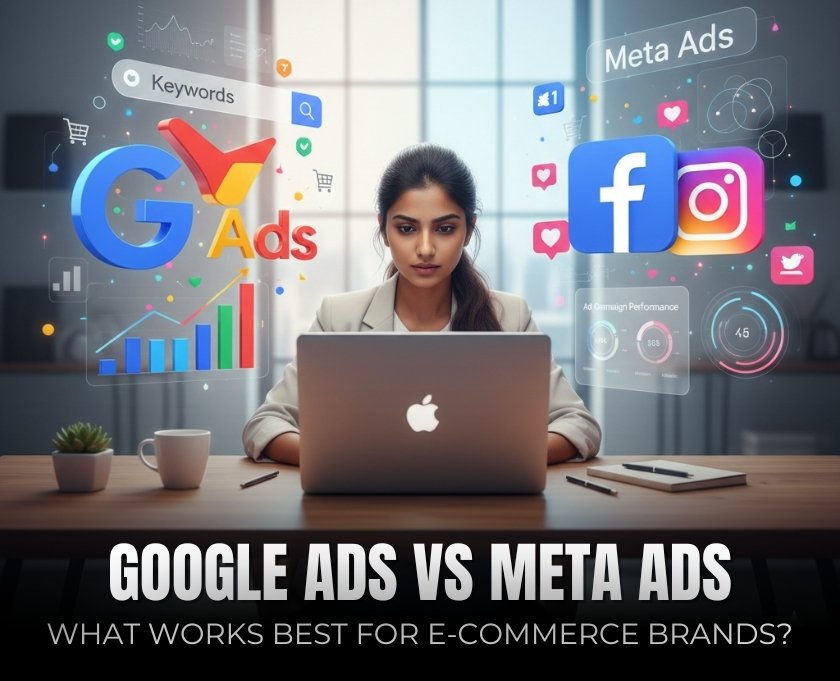
For e-commerce brands looking to scale online sales, paid advertising plays a critical role in customer acquisition and revenue growth. Among the most powerful digital advertising platforms available today are Google Ads and Meta Ads. Both platforms offer unique advantages, but they work very differently. Understanding how each platform functions and where it fits into the customer journey helps e-commerce brands invest their ad budget more effectively.
Google Ads is primarily intent-driven, meaning users are actively searching for products or solutions. When a potential customer types a query such as “buy gym accessories online” or “best kitchen appliances in India,” they already have purchase intent. This makes Google Ads extremely powerful for e-commerce brands focused on conversions, lead generation, and direct sales.
Search ads allow brands to appear at the exact moment a user is ready to buy, while Google Shopping ads visually display product images, prices, and brand names directly in search results. This combination makes Google Ads highly effective for bottom-of-the-funnel marketing. Display ads and YouTube ads further support brand visibility and remarketing, helping e-commerce businesses re-engage users who have already visited their website.
Meta Ads operate on a discovery-based model rather than direct intent. Users on Facebook and Instagram are not actively searching for products; instead, they are scrolling through content. Meta Ads excel at placing visually appealing product creatives in front of highly targeted audiences based on interests, behaviors, demographics, and online activity.
For e-commerce brands, Meta Ads are extremely effective at creating demand, launching new products, and building brand awareness. Video ads, carousel ads, and influencer-style creatives allow brands to tell stories and connect emotionally with potential buyers. Retargeting options through the Meta Pixel also make it easier to convert users who have interacted with ads, visited product pages, or abandoned carts.
One of the biggest differences between Google Ads and Meta Ads lies in user intent. Google Ads reaches customers who already know what they want and are searching for it. This results in higher conversion rates, especially for search and shopping campaigns. Meta Ads, on the other hand, introduce products to users who may not yet be aware of the brand or even the need. While conversion rates may initially be lower, Meta Ads are excellent for filling the top and middle of the sales funnel.
Meta Ads often offer lower cost-per-click compared to Google Ads, making them attractive for brands with limited budgets or those focused on reach and engagement. However, lower cost does not always mean higher quality traffic. Google Ads typically have higher costs per click, but the traffic quality is stronger due to high purchase intent. For e-commerce brands, ROI depends heavily on campaign structure, audience targeting, landing page optimization, and product pricing rather than the platform alone.
For brands aiming to drive immediate sales and capture ready-to-buy customers, Google Ads performs exceptionally well. It is particularly effective for established products with proven demand. Meta Ads are ideal for brands focused on storytelling, community building, and long-term customer relationships. They work best for visually driven products such as fitness gear, fashion, beauty, and lifestyle items.
New e-commerce brands often benefit from starting with Meta Ads to build awareness and collect audience data. Established brands with strong product pages and conversion-optimized websites often see better scalability using Google Search and Shopping campaigns.
Rather than choosing between Google Ads and Meta Ads, most successful e-commerce brands use both platforms together. Meta Ads help attract and educate potential customers at the awareness stage, while Google Ads capture those users later when they actively search for products. This full-funnel approach ensures consistent visibility, stronger brand recall, and higher conversion rates.
By combining discovery-based advertising with intent-based advertising, e-commerce businesses create a seamless customer journey from first interaction to final purchase.
There is no universal answer to which platform is better. Google Ads and Meta Ads serve different purposes within an e-commerce marketing strategy. Google Ads dominate when it comes to intent, conversions, and purchase-ready traffic. Meta Ads excel at storytelling, engagement, and brand growth. When used together with proper tracking and optimization, both platforms can significantly increase sales, customer acquisition, and long-term brand value for e-commerce businesses.